Showing posts with label WHO. Show all posts

Thursday, April 4, 2019

World Health Day 2019

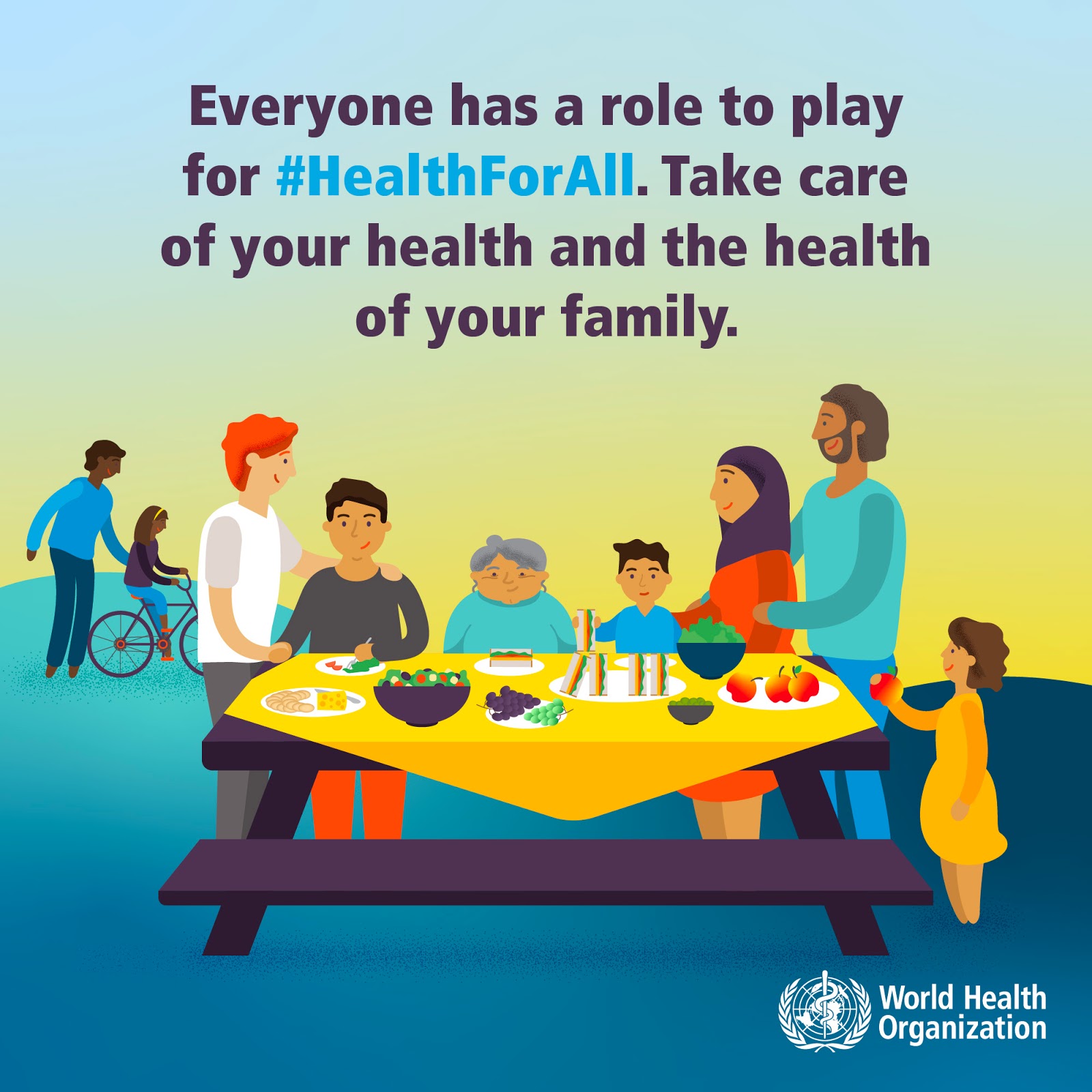
World Health Day is a chance to celebrate health and remind world leaders that everyone should be able to access the health care they need, when and where they need it.


Advocacy events will be held around the world to fuel the momentum of the #HealthForAll movement and to highlight our goal of achieving a fairer, healthier world – in which no one is left
behind. The focus will be on equity and solidarity – on raising the bar for health for everyone, everywhere by addressing gaps in services, and leaving no one behind.

The tagline for World Health Day is: Health for all – everyone, everywhere.

Why universal health coverage and primary health care?

Universal health coverage means that all people have access to the quality health services they need, when and where they need them, without financial hardship. We believe this is possible and it starts with strong primary health care. Primary health care is a whole-of-society approach to health and well-being centered on the needs and preferences of individuals, families and communities.


To make health for all a reality, governments need to invest in quality, accessible primary health care. Health workers need to care and advocate for patients and educate them on how to get and stay healthy. Individuals and communities need to be empowered to take care of their own health.


Health is a human right. Together, we can make health for all a reality.  

                                            ~~~
Trinity Care Foundation is a Public Health Organization, has the Trust registration, PAN, TAN, 12A, 80G, Professional tax and FCRA. It is registered with NITI Ayog, Government of India. It is National Health Mission Partner in Karnataka, India.

Connect with Us:
Email: support@trinitycarefoundation.org | tel: +91 988039 6666 | +91 988035 8888 |

Website : www.trinitycarefoundation.com
Impact : www.flickr.com/photos/trinitycarefoundation/albums

Sunday, March 24, 2019

Key messages to protect heart health

Cardiovascular diseases (CVDs) are disorders of the heart and blood vessels and include coronary heart disease, cerebrovascular disease, rheumatic heart disease and other conditions. Four out of five CVD deaths are due to heart attacks and strokes. Individuals at risk of CVD may demonstrate raised blood pressure, glucose, and lipids as well as overweight and obesity. These can all be easily measured in primary care facilities. Identifying those at highest risk of CVDs and ensuring they receive appropriate treatment can prevent premature deaths. Access to essential NCD medicines and basic health technologies in all primary health care facilities is essential to ensure that those in need receive treatment and counselling.


WHO estimates that more than 17.5 million people died of cardiovascular diseases such as heart attack or stroke in 2012. Contrary to popular belief, more than 3 out of 4 of these deaths occurred in low- and middle-income countries, and men and women were equally affected.

The good news, however, is that 80% of premature heart attacks and strokes are preventable. Healthy diet, regular physical activity, and not using tobacco products are the keys to prevention. Checking and controlling risk factors for heart disease and stroke such as high blood pressure, high cholesterol and high blood sugar or diabetes is also very important.


  • Eat a healthy diet: A balanced diet is crucial to a healthy heart and circulation system. This should include plenty of fruit and vegetables, whole grains, lean meat, fish and pulses with restricted salt, sugar and fat intake. Alcohol should also be used in moderation.
  • Take regular physical activity: At least 30 minutes of regular physical activity every day helps to maintain cardiovascular fitness; at least 60 minutes on most days of the week helps to maintain healthy weight.
  • Avoid tobacco use: Tobacco in every form is very harmful to health - cigarettes, cigars, pipes, or chew-able tobacco. Exposure to second-hand tobacco smoke is also dangerous. The risk of heart attack and stroke starts to drop immediately after a person stops using tobacco products, and can drop by as much as half after 1 year.

Check and control your overall cardiovascular risk: An important aspect of preventing heart attacks and strokes is by providing treatment and counselling to individuals at high risk (those with a 10 year cardiovascular risk equal to or above 30%) and reducing their cardiovascular risk. A health worker can estimate your cardiovascular risk using simple risk charts and provide the appropriate advice for managing your risk factors.


  1. Know your blood pressure: High blood pressure usually has no symptoms, but is one of the biggest causes of sudden stroke or heart attack. Have your blood pressure checked and know your numbers. If it is high, you will need to change your lifestyle to incorporate a healthy diet with less salt intake and increase physical activity, and may need medications to control your blood pressure.
  2. Know your blood lipids: Raised blood cholesterol and abnormal blood lipids increase the risk of heart attacks and strokes. Blood cholesterol needs to be controlled through a healthy diet and, if necessary, by appropriate medications.
  3. Know your blood sugar: Raised blood glucose (diabetes) increases the risk of heart attacks and strokes. If you have diabetes it is very important to control your blood pressure and blood sugar to minimize the risk.

Trinity Care Foundation is a Non-Profit Organization, has the Trust registration, PAN, TAN, 12A, 80G, Professional tax and FCRA. It is registered with NITI Ayog, Government of India. It is National Health Mission Partner in Karnataka, India.

Contact Us : | tel: +91 988039 6666 | +91 988035 8888  |

Website : www.trinitycarefoundation.com
Instagram : www.instagram.com/trinitycarefoundation
Impact : www.flickr.com/photos/trinitycarefoundation/albums
Twitter : https://twitter.com/tcfindia

Thursday, April 6, 2017

World Health Day 2017 - Depression: Let's talk !!!

The World Health Day this year focuses on ‘depression’. 

Worried about the future? Preventing depression during your teens and twenties..


Adolescence and young adulthood present many opportunities – for meeting new people, visiting new places and finding a direction in life. These years can also be a time of stress. If you are feeling overwhelmed rather than excited by these challenges, read on..


What you should know.

  • Depression is an illness characterized by persistent sadness and a loss of interest in activities that you normally enjoy, accompanied by an inability to carry out daily activities, for at least two weeks.
  • In addition, people with depression normally have several of the following: a loss of energy; a change in appetite; sleeping more or less; anxiety; reduced concentration; indecisiveness; restlessness; feelings of worthlessness, guilt, or hopelessness; and thoughts of self-harm or suicide.
  • Much can be done to prevent and treat depression.

What you can do if you are feeling down, or think you may be depressed

  • Talk to someone you trust about your feelings.
  • Seek professional help. Your local health-care worker or doctor is a good place to start.
  • Stay connected. Keep in contact with family and friends.
  • Exercise regularly, even if it’s just a short walk.
  • Stick to regular eating and sleeping habits.
  • Avoid or restrict alcohol intake and refrain from using illicit drugs; they can worsen depression.
  • Continue doing things you have always enjoyed, even when you don’t feel like it.
  • Be aware of persistent negative thoughts and self-criticism and try to replace them with positive thoughts. Congratulate yourself on your achievements.
Remember: There is a lot that you can do to keep mentally strong. If you feel that you may be heading for depression, talk to someone you trust or seek professional help.


Saturday, May 14, 2016

World No Tobacco Day 2016: Get ready for plain packaging


Every year, on 31 May, WHO and partners mark World No Tobacco Day (WNTD), highlighting the health risks associated with tobacco use and advocating for effective policies to reduce tobacco consumption.

For World No Tobacco Day, 31 May 2016, WHO and the Secretariat of the WHO Framework Convention on Tobacco Control are calling countries to get ready for plain (standardized) packaging of tobacco products.

Plain packaging is an important demand reduction measure that reduces the attractiveness of tobacco products, restricts use of tobacco packaging as a form of tobacco advertising and promotion, limits misleading packaging and labelling, and increases the effectiveness of health warnings.

Plain packaging of tobacco products refers to measures that restrict or prohibit the use of logos, colours, brand images or promotional information on packaging other than brand names and product names displayed in a standard colour and font style.


Guidelines to Articles 11 and 13 of the WHO Framework Convention on Tobacco Control (WHO FCTC) recommend that Parties consider adoption of plain packaging.

Plain packaging builds upon other measures as part of a comprehensive multisectoral approach to tobacco control. Policy makers, civil society and the public can take action to ensure that their governments consider adoption of plain packaging.

Facts about plain packaging

Interest in plain packaging is progressing across the globe:

In December 2012, Australia became the first country to fully implement plain packaging.
In 2015, Ireland, the United Kingdom of Great Britain and Northern Ireland and France all passed laws to implement plain packaging from May 2016.
A number of countries are in advanced stages of considering adoption of plain packaging laws.
Goals of WNTD 2016 campaign

World No Tobacco Day 2016 aims to:

Highlight the role of plain packaging as part of a comprehensive, multisectoral approach to tobacco control.
Facilitate policy development by Member States and the globalization of plain packaging by providing informative, compelling and persuasive information.
Encourage Member States to strengthen packaging and labelling measures and restrictions on advertising, promotion and sponsorship as they work towards plain packaging in a step-wise approach.
Support Member States and civil society against tobacco industry interference in political processes leading to adoption of plain packaging laws.

Source : http://www.who.int/campaigns/no-tobacco-day/2016/en/

Saturday, May 11, 2013

Controlling the Tobacco Epidemic among Women...


This fact file focuses on the harm that tobacco marketing and smoke do to women.

About 200 million of the world's one billion smokers are women. The tobacco industry aggressively targets women in order to increase its consumer base and to replace those consumers who quit or who die prematurely from cancer, heart attack, stroke, emphysema or other tobacco-related disease.
Girls and boys start using tobacco for different reasons, and tobacco use harms women and men differently.
Approximately 1.5 million women die every year from tobacco use. Understanding and controlling the tobacco epidemic among women is an important part of any tobacco control strategy.

Smoke Free


  1. More women than men smoke "light" cigarettes: Marketing strategies lure consumers with misleading categories, such as "light" or "low tar". More women than men smoke "light" cigarettes (63% versus 46%), often in the mistaken belief that "light" means "safer". In fact, "light" smokers often engage in compensatory smoking, inhaling more deeply and more frequently to absorb the desired amount of nicotine. 
  2. Tobacco use harms women differently from men: Women who smoke are more likely than those who do not to experience infertility and delays in conceiving. Smoking during pregnancy increases risks of premature delivery, stillbirth and newborn death, and may cause a reduction in breast milk. Smoking increases women's risk for cancer of the cervix. 
  3. Women constitute 64% of deaths from second-hand smoke: Worldwide, second-hand smoke causes 430 000 adult deaths per year. Sixty-four per cent of these deaths occur in women. In some countries, second-hand smoke is a greater threat to women than the possibility that women might start using tobacco. More than 90% of the world's population is still not covered by comprehensive national smoke-free laws. 
  4. People who smoke should avoid exposing the people with whom they live and work to second-hand smoke: Women and children often lack power to negotiate smoke-free spaces, including in their homes, in their workplaces and in other public spaces. Everyone, regardless of age or sex, should be protected from secondhand smoke. 
  5. Controlling tobacco use among women is an important part of any tobacco control strategy: Tobacco prevention and cessation programmes should be integrated into maternal, child and reproductive health services. Warnings about the harmful effects of tobacco must take into account that illiteracy is higher among women than men, and should use clear pictures to ensure that those who cannot read are also able to understand the health risks of tobacco use.

Related Links :
World Health Organization - Department of Gender, Women and Health 
World No Tobacco Day 2013  

Trinity Care Foundation is a Non Governmental Organization focusing on Craniofacial Surgeries, School Health and Outreach Health Programs in Karnataka, India.
                   : Flickr : Facebook : Pinterest : YouTube : Wordpress : 


Sunday, April 7, 2013

World Health Day - 7 April 2013

World Health Day is celebrated on 7 April to mark the anniversary of the founding of WHO in 1948. Each year a theme is selected for World Health Day that highlights a priority area of public health concern in the world. 

The theme for 2013 is high blood pressure.


Blood Pressure = BP


About high blood pressure

High blood pressure – also known as raised blood pressure or hypertension – increases the risk of heart attacks, strokes and kidney failure. If left uncontrolled, high blood pressure can also cause blindness, irregularities of the heartbeat and heart failure. The risk of developing these complications is higher in the presence of other cardiovascular risk factors such as diabetes. One in three adults worldwide has high blood pressure. The proportion increases with age, from 1 in 10 people in their 20s and 30s to 5 in 10 people in their 50s. Prevalence of high blood pressure is highest in some low-income countries in Africa, with over 40% of adults in many African countries thought to be affected.
However, high blood pressure is both preventable and treatable. In some developed countries, prevention and treatment of the condition, together with other cardiovascular risk factors, has brought about a reduction in deaths from heart disease. The risk of developing high blood pressure can be reduced by:
  • reducing salt intake;
  • eating a balanced diet;
  • avoiding harmful use of alcohol;
  • taking regular physical activity;
  • maintaining a healthy body weight; and
  • avoiding tobacco use.
Public Health Initiatives 

Goals: Greater awareness, healthy behaviours, improved detection, and enabling environments

The ultimate goal of World Health Day 2013 is to reduce heart attacks and strokes. Specific objectives of the campaign are:
  • to raise awareness of the causes and consequences of high blood pressure;
  • to provide information on how to prevent high blood pressure and related complications;
  • to encourage adults to check their blood pressure and to follow the advice of health-care professionals;
  • to encourage self-care to prevent high blood pressure;
  • to make blood pressure measurement affordable to all; and
  • to incite national and local authorities to create enabling environments for healthy behaviours.

More information on high blood pressure

Trinity Care Foundation is a Non Governmental Organization focusing on Craniofacial Surgeries, School Health and Outreach Health Programs in Karnataka, India.
                   : Flickr : Facebook : Pinterest : YouTube : Wordpress : 

Tuesday, July 3, 2012

World No Tobacco Day 2012 Theme


Trinity Care Foundation organized an Anti Tobacco Program on June 15th 2012 on the World No Tobacco Day Theme 2012.  “Tobacco Industry Interference” was the theme.

The Health Team from Government of Karnataka Health Department, Trinity Care Foundation and M.R Ambedkar Dental College were present in the KSRTC Bus Stand Kanakapura Town, Ramanagara District, Karnataka, India for providing Health Services to the General Public.

Health Education 
The Program intended to create awareness among  the people about the harmful effects of tobacco consumption highlighting the ill health effects of smoking to both smokers and non-smokers. An Oral Screening with Health Education on the evils of tobacco was given  to the patients and their attendants. Patients were given education about the risk factors associated with tobacco consumption and smoking.


The Program focused  on :
1. Health Education –  ill effects of Tobacco
2. Oral Screening -  Diagnosis and Referral to   M.R Ambedkar Dental College for Further Treatment
3. Dental Treatment – Minor Treatments on the Mobile Dental Unit

World No Tobacco Day 2012 will educate policy-makers and the general public about the tobacco industry's nefarious and harmful tactics. Tobacco industry interference is the theme of this year’s World No Tobacco Day. 
Oral Screening 

The campaign will focus on the need to expose and counter the tobacco industry's brazen and increasingly aggressive attempts  to undermine global tobacco control efforts. The campaign will focus on the need to expose and counter the tobacco industry's brazen and increasingly aggressive attempts to undermine the WHO Framework Convention on Tobacco Control (WHO FCTC) because of the serious danger they pose to public health.

Tobacco use is one of the leading preventable causes of death. Each year, the global tobacco epidemic kills nearly 6 million people. It is on a track to kill more than 8 million people by 2030, by which time approximately 80% of the deaths would occur in low and middle income countries.

A tobacco ban on tobacco marketing can substantially reduce tobacco consumption and consequently tobacco related deaths and disease. We have to look into the causes of tobacco usage and think of new strategies to curb it, said  Dr. Umashankar G K, Trinity Care Foundation.
Dental Treatments

Many patients were diagnosed with oral dental pre-malignant condition and lesions like oral sub-mucous fibrosis, leukoplakia, tobacco quid lesion, smokers palate. Complete oral was done and many patients received treatments on the Mobile Dental Unit stationed at the Bus Stand. 

Counseling Sessions were also discussed with patients and their attendants.The Program was initiated by Government of Karnataka Health Department, Trinity Care Foundation and M.R Ambedkar Dental College.

Trinity Care Foundation is a Non Governmental Organization focusing on Craniofacial Surgeries, School Health and Outreach Health Programs in Karnataka, India.
                   : Flickr : Facebook : Pinterest : YouTube : Wordpress : 

Wednesday, May 30, 2012

World No Tobacco Day 2012


       World No Tobacco Day (WNTD) is commemorated on 31 May every year. The theme for this year’s (2012) WNTD is “Tobacco Industry Interference”.

tobacco
World No Tobacco Day 2012
The campaign focuses on the need to expose and counter the tobacco industry's brazen and increasingly aggressive attempts to undermine the WHO Framework Convention on Tobacco Control (WHO FCTC).

World No Tobacco Day 2012 will educate policy-makers and the general public about the tobacco industry's harmful tactics.

It will also be in keeping with the letter and the spirit of the WHO FCTC. The preamble of the treaty recognizes "the need to be alert to any efforts by the tobacco industry to undermine or subvert tobacco control efforts and the need to be informed of activities of the tobacco industry that have a negative impact on tobacco control efforts".

On World No Tobacco Day 2012, and throughout the rest of the year, WHO will urge countries to put the fight against tobacco industry interference at the heart of their efforts to control the global tobacco epidemic.

Trinity Care Foundation is a Non Governmental Organization focusing on Craniofacial Surgeries, School Health and Outreach Health Programs in Karnataka, India.
                   : Flickr : Facebook : Pinterest : YouTube : Wordpress :